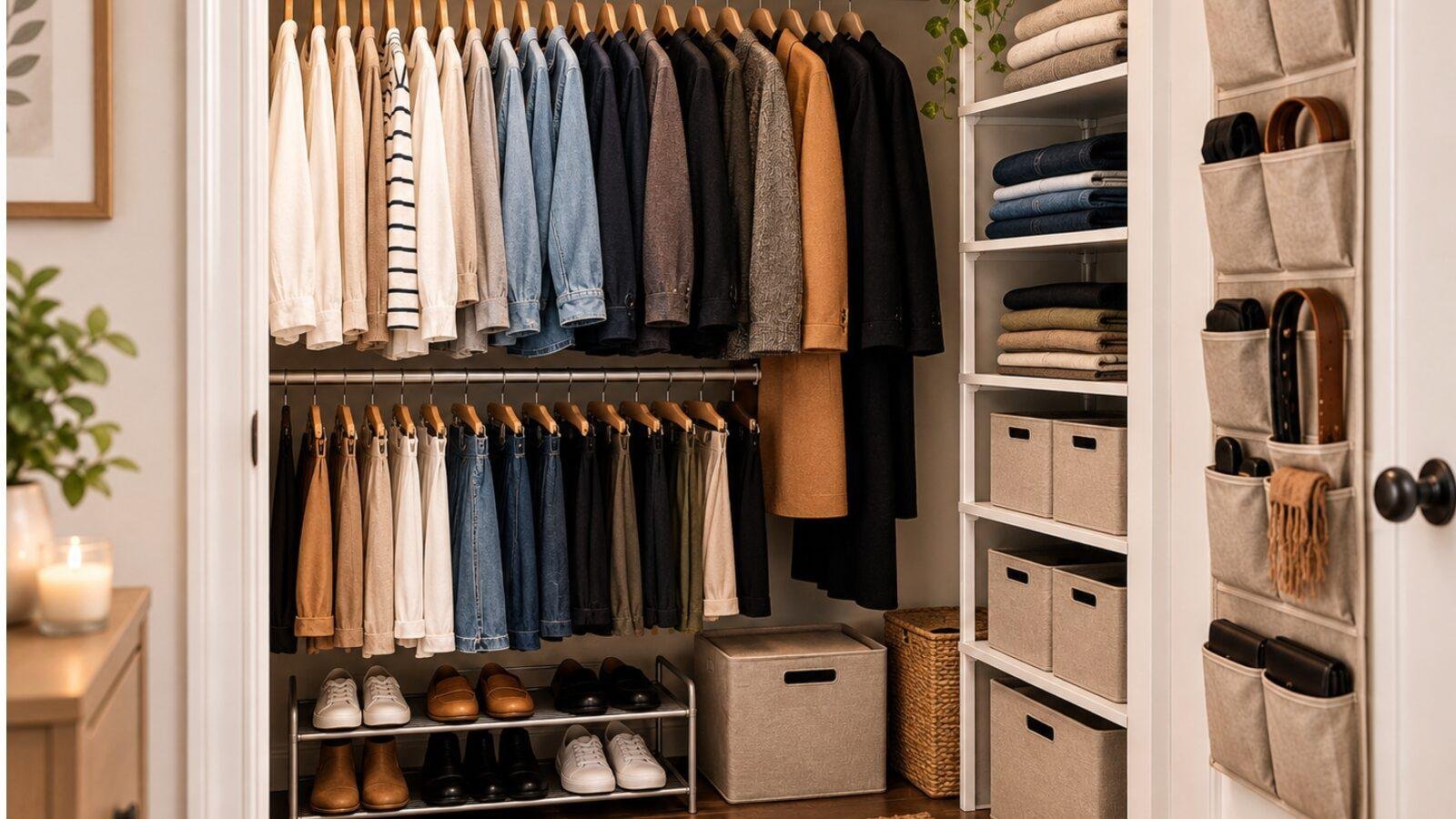
Small closet organization ideas work best when they add usable space instead of just adding containers. This guide covers nine fixes that need no drilling, so you can use them in a rental. Start with the sorting step, then pick the ideas that fit your closet.
If you are organizing more than the closet, our room-by-room guide on how to organize a small apartment shows where this fits in the bigger plan.

Table of Contents
Before you start: empty, measure and sort
Take everything out of the closet. It feels like extra work, but it is the only way to see what you actually own.
Measure the width and depth of the closet, the height of the rod, and the height of any shelf. Write the numbers in your phone. A bin that is slightly too deep is a bin you will return.
Then sort clothes into three piles:
- Keep in the closet: things you wear regularly
- Store elsewhere: off-season items or occasion wear
- Donate, sell or recycle: things that do not fit, are damaged, or have no occasion left
A useful test for borderline items: can you name a specific occasion when you would wear it? If not, it is a candidate to let go.
9 small closet organization ideas that work without drilling
1. Switch to slim, matching hangers
Mixed hangers waste space and make a closet look messy. Slim, uniform hangers sit closer together, so the same rod holds more. Use sturdier hangers for heavy coats.
2. Add a closet rod doubler
A rod doubler hangs from your existing rod and adds a second rail underneath. It works well for shirts, skirts and folded trousers, which are shorter than a dress or coat. Check the weight limit on the package before loading it.
3. Use shelf dividers and stackable shelves
Folded sweaters slump into piles on an open shelf. Dividers keep stacks upright, and a small stackable shelf can turn one shelf into two when the height allows it.
4. Hang an over-the-door organizer
Pockets on the back of the door suit shoes, scarves, belts or small accessories. Make sure the door still closes properly and the organizer does not scrape the frame.
5. Move off-season clothes up high or under the bed
Winter coats in summer, and summer dresses in winter, take up prime hanging space. Store them in labeled, lidded bins on the top shelf or under the bed, and keep the closet for what you wear now.
6. Use the floor with bins or a shoe rack
The floor of a small closet is often wasted. A low shoe rack or a few shallow bins can hold shoes, bags or folded items. Leave the path to the rod clear so you can still reach your clothes.
7. Group by type, then by length
Hang tops together, trousers together, dresses together. Within each group, go from short to long. Grouping makes outfits easier to find, and sorting by length leaves a usable gap underneath short items for a rod doubler or a bin.
8. Add hooks for bags, belts and scarves
Over-the-door or over-the-rod hooks give small accessories a place that is not a pile. Adhesive hooks are fine for very light items, but check the weight rating, clean the surface first, and follow the package instructions.
9. Set a one-in, one-out rule
A closet stays organized only if it does not refill. When a new item comes in, one leaves. It is a habit, not a rule you have to follow perfectly, and it works well alongside a quick seasonal review.
Mistakes to avoid
- Buying organizers before sorting. You will organize things you may not keep.
- Packing the rod tight. Clothes need a little room, or they wrinkle and are hard to take out.
- Putting heavy items on high shelves. Store heavier things low and keep high shelves for light, rarely used items.
- Blocking the door. Keep the closet door closing and the walkway clear.
Quick checklist
- Empty and measure the closet
- Sort into keep, store elsewhere and donate
- Switch to slim, matching hangers
- Add a rod doubler if your rod height allows
- Use dividers or a stackable shelf
- Move off-season items to bins up high or under the bed
- Use the door and floor
- Set a one-in, one-out habit
Frequently asked questions
How do I organize a small closet with no shelves?
Use a freestanding shelf or stackable shelf unit if there is room, or hang fabric shelf organizers from the rod. Bins on the closet floor and an over-the-door organizer also add storage without any installation.
How can I add closet space in a rental?
Choose products that need no drilling: rod doublers, over-the-door organizers, hooks that hang over the rod, shelf dividers and freestanding units. Check your lease before attaching anything to walls.
Should I fold or hang my clothes?
Hang items that wrinkle easily, such as dresses, shirts and jackets. Fold knitwear and soft items that can stretch on hangers. Folded items are easier to store in bins and on shelves.
How often should I reorganize my closet?
A quick review once a season is usually enough. If the closet keeps falling apart, the system is probably too complicated, so simplify it before adding new products.
Conclusion
The best small closet organization ideas make the space you have work harder: slim hangers, a second rail, smart shelves and a habit of letting one item go when another comes in. Start with the sort, then add only the products you actually need. For the rest of your home, see our guide on how to organize a small apartment. If you want more small closet organization ideas for rentals, start with the smallest change first and keep only what fits comfortably. For rental-friendly storage guidance, see the advice from Better Homes and Gardens. These small closet organization ideas work best when you repeat the sort each season.
Closets in bedrooms benefit from the same approach as these small bedroom storage ideas.